The Calendar Debt Check to Catch Overbooked Weeks Before They Break
Jamie

Calendar debt is the overload you don’t notice until it costs you
Most people can feel when their week is “too full,” but they can’t always point to why. The problem isn’t just having a busy calendar—it’s what happens when you keep stacking commitments without paying down the hidden costs: prep time you didn’t schedule, follow-ups that spill into evenings, deep work that gets pushed to “next week,” and meetings that multiply because no one remembers decisions.
That accumulation is calendar debt. Like any debt, it feels manageable—right up until an overbooked week breaks your system (missed deadlines, sloppy handoffs, reactive work, and a constant sense of being behind).
The simplest prevention is a short weekly ritual: a 15-minute Friday audit designed to spot debt early, rebalance next week, and protect the work that actually moves things forward.
The “Calendar Debt” Check: a 15-minute Friday audit
This audit works best at the end of your workweek (Friday afternoon is ideal) because you can still influence next week before it begins. You’re not trying to plan perfectly—you’re trying to identify risk: where the schedule is unrealistic, where context switching will spike, and where work will leak into personal time.
Minute 0–3: Scan next week like a project manager
Open next week in a weekly view and do a fast scan without editing anything yet. You’re looking for patterns:
- Dense clusters of meetings (especially back-to-back blocks).
- High-variance days where the schedule swings from deep work to calls to admin repeatedly.
- “Invisible work” gaps—days that look open but are actually full of deadlines, reviews, writing, or implementation.
- Recovery gaps—no breathing room after intense sessions (customer calls, interviews, incident reviews, negotiations).
If you already feel resistance when you look at a day, that’s usually calendar debt showing itself early.
Minute 3–6: Count three debt signals
Rather than guessing, measure a few simple signals. You only need three to spot trouble:
- Meeting load per day: If any day crosses your personal threshold (for many people, 4–5 hours), assume execution will slip.
- Context switches: Count how many distinct modes you’ll be in (strategy, 1:1s, build work, support, finance, hiring). More modes usually means less real output.
- Unscheduled outputs: Identify deliverables that aren’t represented on the calendar (a proposal due Tuesday, a doc you promised, a bugfix you’re carrying). These are the fastest route to late nights.
The goal is not precision—it’s early detection. If you find multiple red flags on the same day, treat that day as fragile.
Minute 6–10: Translate tasks into time blocks
Calendar debt often comes from treating tasks like they’re weightless. A task list can grow without friction; a calendar can’t. Paying down debt means translating key tasks into scheduled work.
Pick the 3–6 most important outcomes for next week and put real time on the calendar for them. This is where a unified workspace helps: in Routine, tasks can become scheduled actions through time blocking, and meeting notes can sit next to the commitments they generate—reducing the “I’ll remember later” trap.
As you block time, use these rules to stay realistic:
- Add setup and wrap time: A 30-minute meeting often needs 10 minutes before and after. Put it somewhere.
- Protect deep work windows: Don’t leave your best work to “open time.” Reserve it.
- Don’t overfit: You’re creating capacity and clarity, not a brittle schedule that collapses after one delay.
Minute 10–13: Renegotiate the week before it starts
This is the part most people skip, and it’s where calendar debt keeps compounding. If the week doesn’t work, change it while it’s still early and socially easy.
Make one of these moves:
- Move: Shift non-urgent meetings away from overloaded days.
- Merge: Combine two meetings with overlapping attendees/outcomes.
- Shorten: Turn 45 minutes into 25, or 30 into 15, when the agenda is narrow.
- Asynchronous swap: Replace a meeting with a written update and a decision deadline.
- Decline with an alternative: Offer times that fit your capacity rather than defaulting to “sure.”
If you manage a team, this is also a good time to watch for system-wide overload: recurring meetings that no longer serve decisions, or calendar patterns that create constant interruptions for builders.
Minute 13–15: Create two buffers that prevent breakage
End the audit by adding two buffers that stop small disruptions from turning into a broken week:
- A “catch-up” block: 30–60 minutes midweek to handle spillover, follow-ups, and loose ends.
- A “thinking” block: 30 minutes for planning, writing, or decision-making—work that disappears when you’re reactive.
These buffers look optional, but they’re what keep your calendar from becoming a zero-slack system that fails under normal conditions.
How to spot calendar debt early (before you feel it)
By the time you feel behind, the week is often already lost. These are earlier indicators that your schedule is taking on debt:
- Back-to-back meeting chains that leave no time to capture decisions or assign next actions.
- Recurring meetings that generate more meetings because decisions aren’t documented.
- “Open calendar” illusions where the week looks free but deadlines and deliverables aren’t visible.
- Task drift—important tasks keep moving forward a day at a time.
If your follow-ups feel like a second job, you likely have a notes-to-actions gap. Tightening that loop is often the difference between a sustainable calendar and a fragile one. (If your overload is coming from constant pings and tool chaos, the same logic applies in systems too—an integration debt audit checklist can reveal where noise is stealing execution time.)
Make the audit easier by standardizing your weekly view
The audit becomes effortless when the same elements show up every week in one place:
- Calendar commitments (meetings, blocks, deadlines).
- Tasks translated into time instead of living as an infinite list.
- Notes tied to the event so decisions don’t vanish.
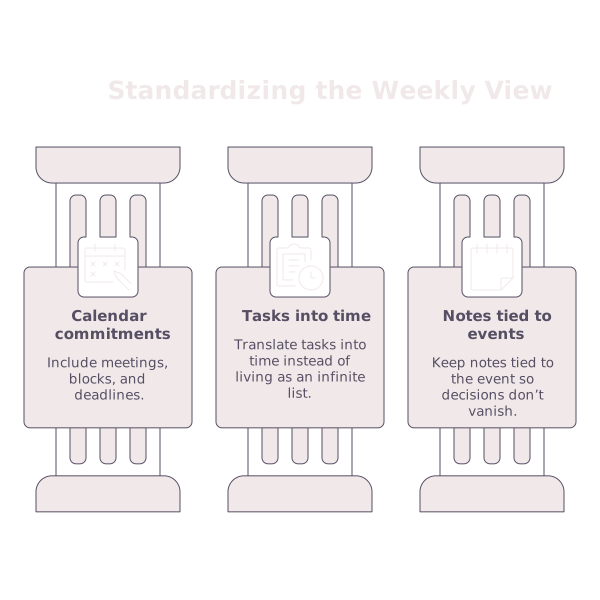
That’s why an all-in-one workflow matters. When your calendar, tasks, and notes are disconnected, debt builds in the gaps: you forget to schedule the work implied by meetings, you lose follow-ups, and you underestimate how long execution will take. Keeping those elements together reduces friction and makes the 15-minute check actually doable every Friday.
What this looks like in a real week
Imagine next Tuesday is stacked: three calls in the morning, a team meeting after lunch, and “open time” late afternoon. On paper it looks fine. During the audit you notice:
- 4.5 hours of meetings means almost no maker time.
- Each call has prep and follow-up that isn’t scheduled.
- A deliverable due Wednesday has no time block.
You pay down debt by moving one call to Thursday, shortening the team meeting, blocking 90 minutes for the deliverable, and adding a 30-minute catch-up buffer. The week didn’t get “less busy”—it became less brittle.
Keep it lightweight so it actually happens
The Calendar Debt Check only works if it’s small enough to repeat. Set a recurring 15-minute block on Fridays. Run the scan. Fix the obvious overload. Add buffers. Then stop. The win is consistency: you catch overbooked weeks before they break, and you start Monday with a calendar you can trust.