The 90-Day Integration Reality Check for AI Agents in CRM, ERP, Billing, and ITSM
Jamie
Why “automation debt” shows up in the first 90 days
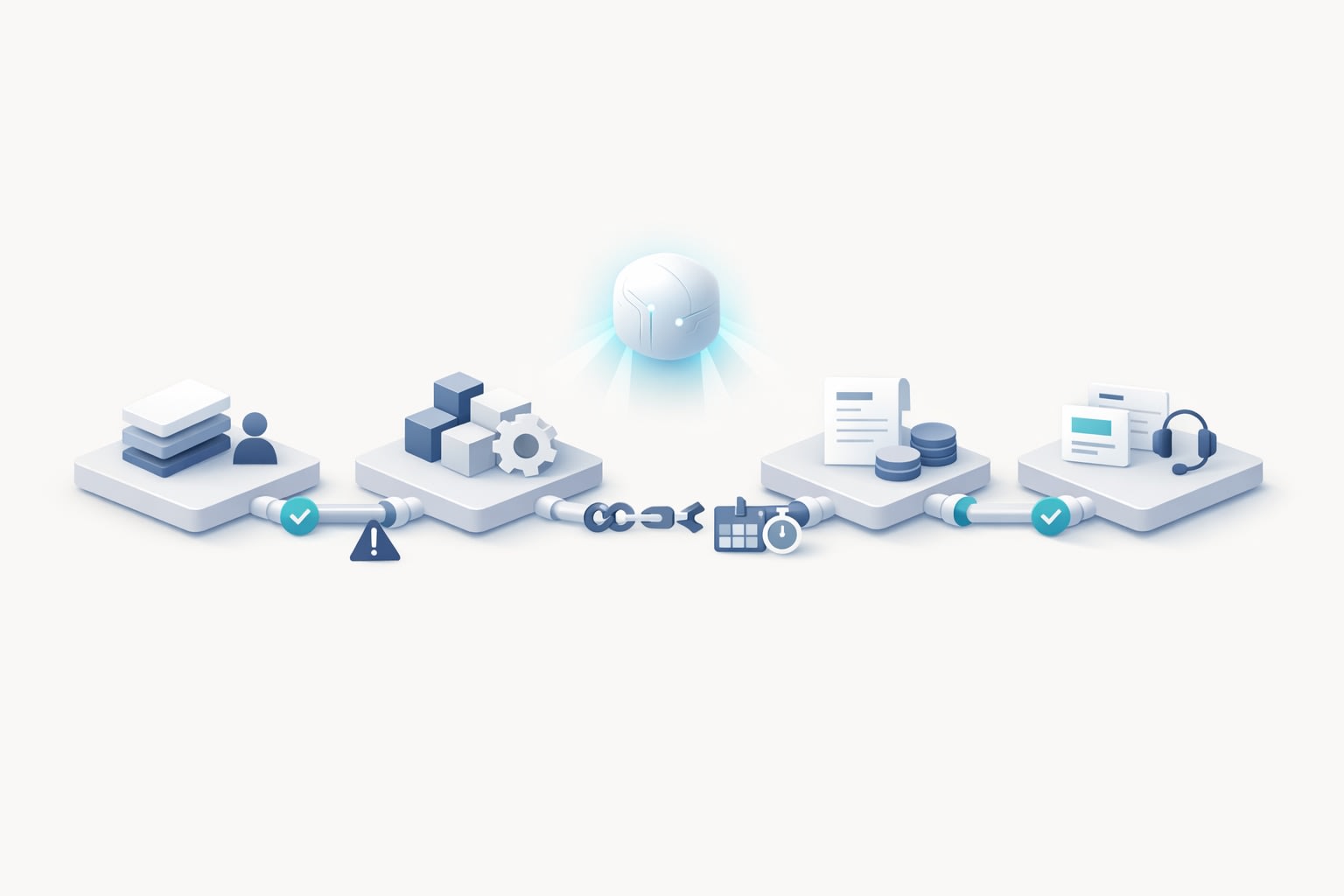
When AI agents only read from systems, integration risk is mostly about retrieval quality. The moment they can also write—creating cases in ITSM, issuing refunds in billing, updating CRM fields, or triggering ERP workflows—the integration becomes a production surface. “Automation debt” is what accumulates when those write paths are shipped faster than they can be governed: duplicated automations, undocumented field mappings, brittle business rules, and silent failures that only appear in edge cases.
The first 90 days matter because this is when teams typically move from a proof of concept to real operational load. Volumes rise, more teams request “just one more workflow,” and quick fixes (hard-coded IDs, one-off transformations, permissive permissions) become permanent. The goal of a 90-day reality check isn’t to slow adoption—it’s to make sure each new automation reduces operational cost instead of moving it into the integration layer.
A practical definition of automation debt
Automation debt is the gap between what your AI agent workflows do and what your organization can reliably operate—with audits, approvals, monitoring, and safe change management. You see it when:
- Two systems disagree on the “source of truth” for customer status, entitlements, or billing state.
- Write actions succeed in one system but fail in another, leaving partial updates.
- Agents can take actions that violate policy (refund thresholds, PII handling, approval rules).
- Small schema changes in CRM/ERP silently break downstream automations.
- Support, Sales, and Ops each define near-identical workflows with different naming and logic.
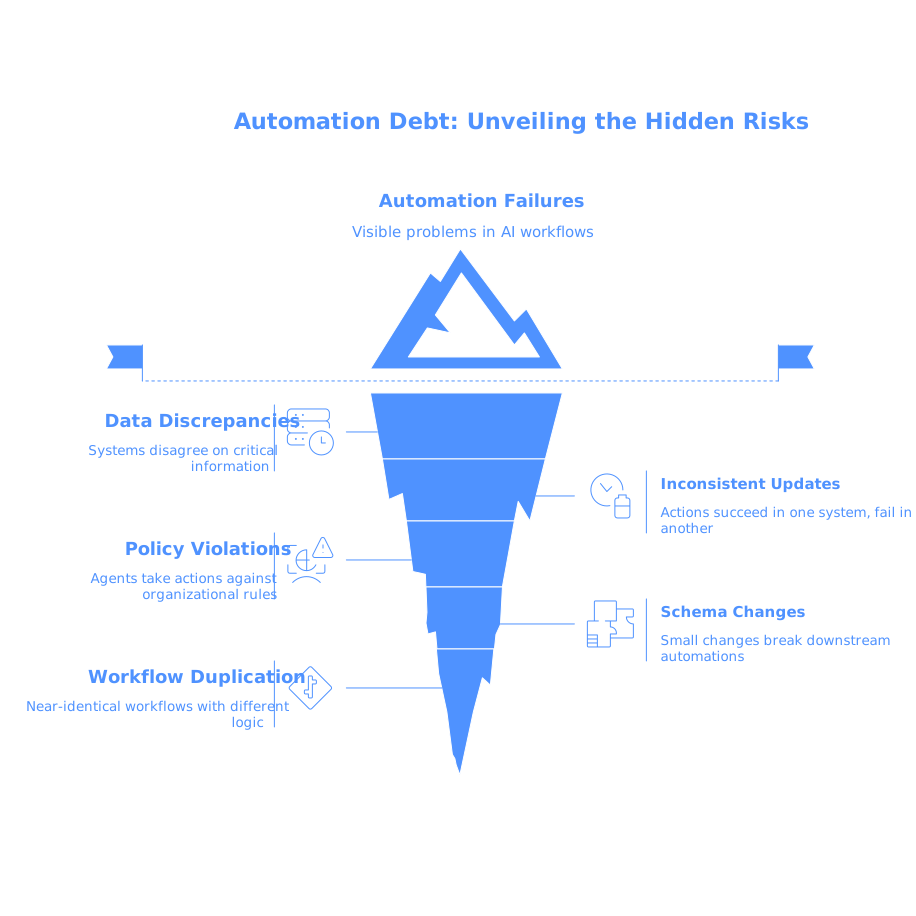
In other words: the automation works—until it doesn’t—and then it’s hard to diagnose, hard to roll back, and hard to trust.
The 90-day integration reality check framework
Days 1–30: make write actions safe before you make them fast
The most common mistake in early deployments is treating “write” as a single capability. In reality, every action needs its own guardrails. Start with a small set of high-value actions and formalize them as products:
- Define action contracts: required inputs, validations, expected outputs, and failure modes. If the agent creates a credit memo in billing, specify what must be present (order ID, reason code, amount limits) and what the response must return (transaction ID, posting status).
- Introduce approval tiers: low-risk actions (tagging, internal notes) can be automatic; medium-risk actions (plan changes, RMA creation) can require a human checkpoint; high-risk actions (refunds above threshold, account closure) should be gated by policy and explicit approval.
- Use idempotency and deduplication: actions should be safe to retry. Duplicate case creation and double refunds are classic automation debt. Every write path should carry a correlation ID and dedupe key.
- Start with “shadow writes” where possible: simulate outcomes, log what would happen, then graduate to real writes. This reduces the cost of inevitable early prompt and mapping changes.
This is where an agent platform designed for end-to-end service workflows helps, because it can treat actions as governed primitives rather than ad hoc API calls. Platforms like typewise.app emphasize controlled actions, approvals, and evaluation before changes go live—use that philosophy even if your stack is custom.
Days 31–60: standardize cross-system semantics
Most integration issues aren’t API problems. They’re meaning problems. “Customer,” “subscription,” “asset,” “ticket,” and “invoice” can have different identities across CRM, ERP, billing, and ITSM. By day 60, aim to normalize semantics so agents don’t stitch logic together from inconsistent fields.
- Establish sources of truth: pick one system for each canonical object. Example: billing owns payment state; ERP owns fulfillment state; ITSM owns incident status; CRM owns account hierarchy.
- Create a shared field dictionary: document mappings and acceptable values. If CRM has “Plan_Tier” and billing has “Product_Code,” define the translation and keep it versioned.
- Harden taxonomy: reason codes, disposition codes, and ticket categories must be consistent if you want stable reporting and predictable routing.
- Handle partial identity: agents will face missing order IDs, outdated emails, or merged accounts. Define a safe lookup sequence and escalation rules.
Operationally, this is also when teams discover duplicate work requests across channels—Support hears it in tickets, Sales hears it in renewals, and product hears it in forums. If your integration layer doesn’t share a consistent “issue fingerprint,” you’ll duplicate automations and insights. The same pattern is covered in how to spot duplicate requests across support, sales, and forums, and it applies directly to agent workflows and routing logic.
Days 61–90: make observability and change management non-negotiable
By day 90, the question isn’t “can the agent do it?” It’s “can we safely evolve it?” That requires instrumentation that’s specific to AI agents operating across multiple systems.
- End-to-end traceability: every resolution should have a trace that links: the conversation, the intent, the retrieved knowledge, the selected action, and the system writes (with IDs and timestamps).
- Action-level monitoring: track success rate, retry rate, average latency, and top failure reasons per integration. “HTTP 200” isn’t success if the business object is in the wrong state.
- Policy and compliance checks: log why an action was allowed (policy rule matched) and what data was used. This is essential for audits and regulated environments.
- Staging, simulation, and evaluation: changes to prompts, workflows, or mappings should be tested on historical conversations and synthetic edge cases. Promote only when metrics stay within bounds.
- Rollback strategy: define what rollback means for each action. Some writes can be reverted; others require compensating actions (e.g., refund reversal, case reopen).
Many teams already struggle with integration noise and unclear ownership long before AI agents arrive. Bringing agents into the stack makes that pain visible faster. A quick way to prevent new chaos is to run a periodic integration audit focused on signal vs. noise and ownership boundaries—similar in spirit to an integration debt audit checklist, but extended to include agent actions and policy gates.
Common failure modes when agents read and write across systems
- Split-brain updates: the agent updates CRM but fails to update ERP, so downstream teams act on stale state.
- Over-permissive credentials: a single token with broad scopes makes early development easy and later governance painful. Prefer least-privilege per action.
- Hidden coupling through text fields: storing critical state in notes or free-form fields makes automations fragile and reporting unreliable.
- Workflow drift: different teams tweak the “same” workflow in different ways, and nobody can tell which version is correct.
- Silent escalation failure: the agent intends to hand off to a human but the ITSM/queue routing rule misfires, creating the illusion of coverage.
What “good” looks like at the end of 90 days
- A small set of high-impact write actions with clear contracts, permissions, and approval tiers.
- Canonical objects and field mappings that teams actually reference and maintain.
- End-to-end traces for every automated resolution, with searchable action outcomes and IDs.
- A repeatable release process: simulate, evaluate, approve, deploy, monitor, and roll back if needed.
- A shared operating model so Support, Sales, and Ops don’t each build parallel automations.
This is the point where scaling becomes easier: adding a new channel or integration doesn’t multiply risk, because your governance and observability scale with it. It’s also where multi-agent orchestration starts to pay off—specialist agents can operate within their action boundaries while a supervisor layer coordinates handoffs and approvals without losing context.