Seed List Poisoning and Legacy Spam Traps in Inbox Placement Testing
Jamie

Why seed tests can mislead when the seed list is “poisoned”
Inbox placement testing is supposed to answer a simple question: “Where does my email land?” Many teams rely on seed lists—sets of monitoring inboxes across Gmail, Outlook, Yahoo, and others—to measure whether messages reach the inbox, promotions tab, or spam folder.
The problem is that seed tests are only as trustworthy as the health of the seed accounts. When seed accounts are repeatedly hit by high-volume testing, shared across multiple senders, or recycled over time, they can become unrepresentative of real recipients. This is commonly described as seed list poisoning: a situation where the seed addresses or domains accumulate negative signals that skew results, making otherwise healthy mail look “worse” than it would for normal subscribers—or occasionally the reverse.
How legacy spam traps enter the picture
Spam traps are email addresses used to identify poor sending practices. Some are pristine (never opted in) and some are recycled (abandoned addresses repurposed for monitoring). “Legacy” spam traps often refer to addresses that have existed a long time and are now embedded in old lists, purchased data, or historic CRM exports.
Seed lists and spam traps are not the same thing, but they can intersect in practice:
- Reused testing addresses can start to behave like traps. If a seed inbox is never used like a human mailbox—no real conversations, no organic subscriptions, no normal reading patterns—its engagement profile can look artificial.
- Overexposed seeds can collect reputation baggage. If many senders test to the same seed addresses, those inboxes may become correlated with repetitive, template-like mail patterns.
- Old monitoring accounts may be maintained inconsistently. Dormant accounts, weak authentication configurations, and aging domains can create deliverability artifacts that don’t match your real audience.
The result: a seed test might report “spam placement” that is driven more by the seed ecosystem than by your sender reputation with actual customers.
What “poisoning” looks like in real testing results
Seed list poisoning is rarely obvious. It usually shows up as inconsistency across tests, contradictions versus production metrics, or “sticky” spam placement that doesn’t respond to improvements. Common patterns include:
- Spam placement stays high even after major fixes. You add DMARC, tighten list hygiene, reduce complaint risk, and yet seed spam rates barely move.
- Big swings between seed providers or seed groups. One set of seeds says 90% inbox; another says 30% inbox—without any meaningful change in sending.
- Results that don’t match subscriber reality. Open/click rates and support tickets indicate most recipients are receiving mail, but seed tests claim widespread spam.
- Over-indexing on a single mailbox type. Gmail seeds might look fine while Outlook seeds look terrible (or vice versa), but troubleshooting reveals no provider-specific issues in headers, authentication, or content.
When this happens, it’s tempting to chase the seed score. A better approach is to treat seeds as one lens and validate with additional signals: real-user engagement trends, complaint rates, bounce codes, authentication pass rates, and inbox placement monitoring that’s continuously refreshed and segmented.
Why seed accounts become “legacy” and risky over time
Seed testing has been around for years, and many organizations still use long-lived monitoring inboxes because they’re convenient. But longevity is a downside when the goal is to approximate the average recipient. Long-lived seeds can accumulate characteristics that differ from real users:
- Unnatural engagement history. Seeds often receive huge volumes but interact rarely, or interact in repetitive ways.
- Predictable traffic patterns. Tests run on a schedule, with near-identical subjects and templates.
- Cross-sender contamination. Shared seeds are exposed to many unrelated brands, industries, and sending cadences.
- Address exposure. Widely known seed addresses can be scraped, resold, or added to lists—creating background noise and additional negative signals.
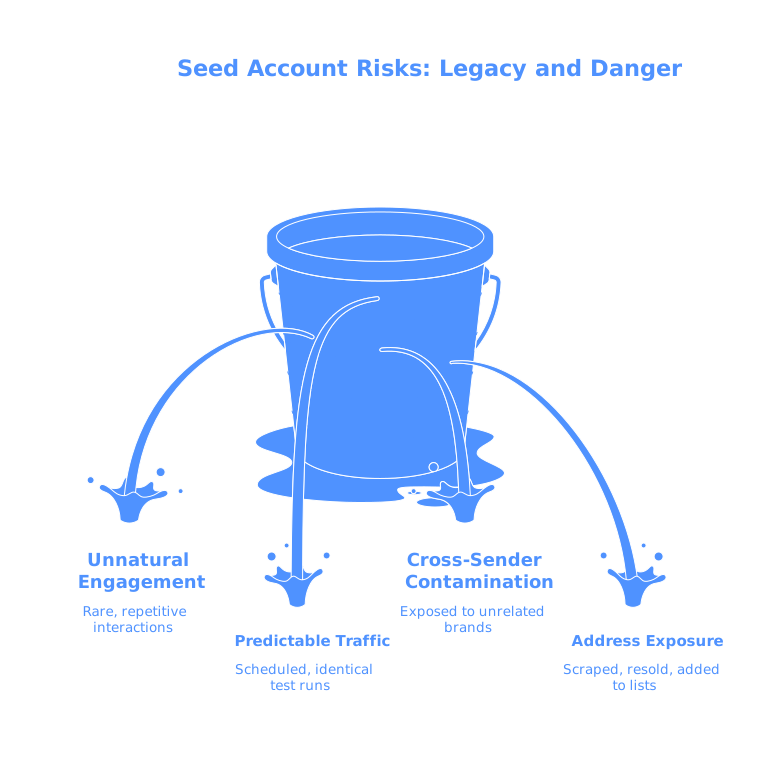
Even if no single factor is decisive, the combined footprint can make the seed inbox a poor proxy for the inboxes that matter: your leads, customers, and members.
What to do instead of blindly trusting seed scores
1) Treat seed tests as diagnostics, not a KPI
Use seed tests to compare configurations (authentication changes, template variants, sending domain shifts) and to detect major issues quickly. Avoid using one seed score as a headline KPI for deliverability. Inbox placement is contextual: it varies by provider, recipient history, and engagement.
2) Refresh and segment your testing approach
If you use seed accounts, rotate them. Use multiple independent seed groups, and keep separate pools for different streams (cold outreach, product notifications, newsletters). Mixing radically different mail types into one seed cohort makes it harder to interpret the results.
Also, separate “warming” behavior from “testing” behavior. Seeds that are constantly used as test endpoints should not be expected to behave like normal subscribers indefinitely.
3) Validate with continuous inbox vs spam tracking per mailbox
One-off tests are easy to overinterpret. Continuous monitoring helps you catch trends and correlate changes with what you actually shipped (new copy, new sending cadence, new domains). A platform like Mailwarm includes Live Inbox vs Spam Placement Tracking designed for ongoing visibility across mailboxes and SMTPs, which can reduce the temptation to react to a single anomalous seed run.
4) Improve sender reputation with realistic engagement signals
When seed accounts are “too synthetic,” they don’t help your reputation—and sometimes they distort your understanding of it. The goal is to build a sender profile that looks like real, wanted mail over time: consistent volumes, stable authentication, and credible engagement. Warmup programs can help here when they simulate natural interactions (opens, replies, marking as important, moving out of spam) without forcing sudden volume spikes.
Mailwarm’s warmup model is built around daily, scheduled interactions across a large network of warmup accounts, aimed at making engagement patterns look organic rather than test-like. That matters because filters respond to patterns, not only to isolated messages.
5) Reduce the odds of hitting legacy traps in your real list
Seed poisoning is one issue; legacy spam traps in your production list are another—and both can exist at once. Practical steps that reduce trap risk include:
- Use confirmed opt-in where feasible for high-risk acquisition sources.
- Harden list hygiene by suppressing persistently unengaged addresses and removing obvious role accounts when appropriate for your use case.
- Audit old imports and avoid re-mailing dormant segments without a re-permission strategy.
- Watch bounce and complaint signals by provider; they often show trouble earlier than a seed score.
If you’re trying to reconcile conflicting signals—good engagement but poor seed placement—run a deliverability audit that includes headers, authentication alignment, volume patterns, and provider-specific responses. Mailwarm positions a free deliverability audit as a starting point, which is useful when you need to distinguish a genuine reputation issue from a testing artifact.
How to interpret a “bad” result when you suspect poisoning
When a seed test reports poor placement, ask a few concrete questions before you change your sending program:
- Is the result reproducible across a different seed group or a freshly created monitoring inbox?
- Do real-user metrics agree? Look at provider-level engagement and delivery signals, not just overall averages.
- Did anything change? New domain, new IP, sudden volume shift, template overhaul, or list source change?
- Is the issue isolated to one provider? If yes, focus on that provider’s typical failure modes (authentication alignment, formatting, complaint sensitivity, or throttling patterns).
Seed lists can still be valuable, but they’re easiest to use when you assume they can drift over time. The more you design your monitoring to mimic real recipients—and the more you rely on continuous, mailbox-level tracking—the less likely you are to be misled by legacy artifacts.