From Sales Call Transcript to Coachable Moments With AI Scorecards
Jamie

Turn call transcripts into coachable moments without adding manager overhead
Sales teams don’t lack data. They lack a repeatable way to turn conversations into coaching that shows up in the next week’s pipeline outcomes. Call recordings and transcripts can either become an archive that nobody revisits, or a practical system that produces consistent feedback, measurable skill progress, and clearer forecasts.
The difference is a framework that starts with highlights and ends with weekly coaching metrics. Done well, it’s the same workflow every week: capture the best evidence from calls, score it against a small set of behaviors, and roll those scores into trends that managers can coach against. Tools like Fathom make this workflow easier because you can search, clip highlights, and standardize what “good” looks like across a team without asking reps to take detailed notes mid-call.
A repeatable framework from transcript to scorecard to weekly metrics
Think of the system as three layers that build on each other:
- Evidence layer: transcript snippets, time-stamped highlights, and clips that show what happened.
- Evaluation layer: an AI scorecard that maps evidence to a few observable behaviors.
- Coaching layer: weekly metrics and one or two targeted behaviors for practice.
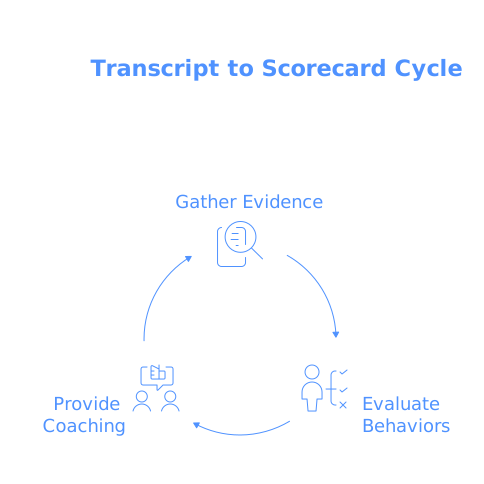
When teams skip the evidence layer, scorecards become subjective. When they skip evaluation, coaching becomes a collection of anecdotes. When they skip weekly metrics, improvement is impossible to track.
Step 1: Define what “coachable” means for your sales motion
Before you touch a transcript, set the scope. The goal is not to evaluate everything; it’s to evaluate what actually changes outcomes in your motion. For most B2B teams, that means a small list of behaviors that appear (or fail) in calls:
- Agenda setting and timeboxing
- Discovery depth (problem, impact, current workflow)
- Qualification signals (timing, stakeholders, constraints)
- Value articulation tied to customer language
- Objection handling (clarify, validate, respond, confirm)
- Next steps with owners and dates
Keep this list tight—six to eight behaviors is plenty. If you build a 25-line scorecard, the team will stop trusting it or stop using it.
Step 2: Turn “highlights” into labeled evidence you can reuse
Highlights are your raw material. The trick is to label them in a way that supports scoring and coaching later. Instead of “good call” or “pricing talk,” use labels that match behaviors:
- Discovery: “Asked about current process” or “Quantified impact”
- Messaging: “Mirrored customer phrasing”
- Objection: “Clarified objection before answering”
- Close: “Confirmed next step date and stakeholder”
This is where searchable transcripts and consistent highlighting matter. If your team already uses a meeting partner to capture recordings and transcripts, you can standardize the labeling so that managers can later pull examples by keyword, tag, or folder and build coaching libraries (for onboarding and ongoing enablement).
Step 3: Build an AI scorecard that is behavior-based, not vibe-based
An effective AI scorecard reads like a rubric. It should focus on observable actions and give the AI clear criteria. A practical pattern is: behavior definition → evidence request → scoring bands.
For example, a single scorecard item might look like:
- Behavior: Sets an agenda and confirms it with the buyer.
- Evidence to look for: A question or statement in the first 2–3 minutes that proposes an agenda and asks for confirmation.
- Scoring: 0 = absent, 1 = implied but not confirmed, 2 = explicit and confirmed.
Repeat this format across all behaviors. Avoid ambiguous categories like “confidence” or “executive presence” unless you can tie them to concrete, transcript-verifiable signals.
Step 4: Tie each score to a “coachable moment” prompt
Scorecards become useful when they don’t just score—they generate coaching. Add a short prompt for each behavior that produces a rep-facing takeaway:
- If low: what to do differently next time (one sentence)
- Practice drill: a 60-second role-play or rewrite exercise
- Example: one highlight clip that demonstrates the behavior
This keeps managers from writing the same feedback repeatedly. If you’ve ever felt like you’re paying “feedback debt” (repeating identical coaching across reps and calls), it’s worth formalizing what repeats and capturing it as reusable guidance. That idea maps well to the broader concept in Feedback debt and how to spot duplicate requests across support, sales, and forums.
Step 5: Convert individual scorecards into weekly coaching metrics
The weekly view should answer two questions:
- What’s improving? (trend by behavior over time)
- What should we coach next? (lowest scores with highest impact)
A simple weekly coaching dashboard can include:
- Score by behavior (team average, rep average, and variance)
- Coverage (how many calls were scored per rep that week)
- Top 3 coachable moments (time-stamped examples to review)
- One “focus behavior” per rep for the next week
Resist the urge to turn this into a leaderboard. The purpose is coaching and consistency, not public ranking. Keep the team view for managers and enablement; keep the rep view focused on one or two behaviors they can actually change next week.
How to keep the framework consistent across managers and segments
Standardize the vocabulary
If different managers use different labels (“discovery depth” vs. “needs analysis”), the data won’t roll up cleanly. Create a shared glossary and bake it into scorecard items, highlight tags, and coaching notes. If your org has custom product terms or niche customer language, define a controlled vocabulary so transcripts and searches stay reliable across the team.
Use segment-aware scorecards without fracturing the system
Enterprise, mid-market, and SMB calls can require different behaviors. Keep 70–80% of the scorecard consistent across segments, then add a small segment-specific section (for example, multi-threading and stakeholder mapping for enterprise).
Make “evidence required” a rule
A score without evidence will be challenged—and it should be. Require that each scored behavior links back to at least one transcript snippet or clip. That single rule dramatically improves trust, and it also makes coaching faster because the rep can see the moment in context.
What a weekly coaching cadence can look like in practice
A cadence that teams can sustain usually looks like this:
- Monday: managers review last week’s trends and pick one team-wide focus behavior
- Mid-week: 1:1 coaching uses two clips—one “do more of this,” one “try this instead”
- Friday: enablement curates 3–5 highlight clips into a playlist for the focus behavior
This is where a meeting system that supports searchable transcripts, highlight clips, playlists, and team visibility becomes an operational advantage. When managers can quickly find examples and reps can revisit them without digging through long recordings, coaching becomes routine rather than heroic.
Common pitfalls and how to avoid them
Too many metrics, not enough action
If your dashboard has 30 charts but reps can’t name what to do differently on their next call, the framework is failing. Limit weekly focus to one or two behaviors per rep.
Inconsistent naming and messy tracking
When labels and fields vary, trend reporting breaks and managers stop trusting the numbers. Treat naming consistency as a systems problem, not a training problem. The same way marketing teams clean up campaign tracking, sales teams need a disciplined taxonomy for call tags and coaching themes. The mindset behind the UTM tax and the fix for inconsistent campaign naming applies directly here.
Scorecards that don’t match the sales stage
Discovery calls, demos, and late-stage negotiations should not be judged by identical expectations. Use stage-aware scoring: keep a core rubric, then vary a few items by stage so the feedback stays relevant.