Why AI Citations Break When Attribution Leaks and How Persistent Entity IDs Fix It
Jamie
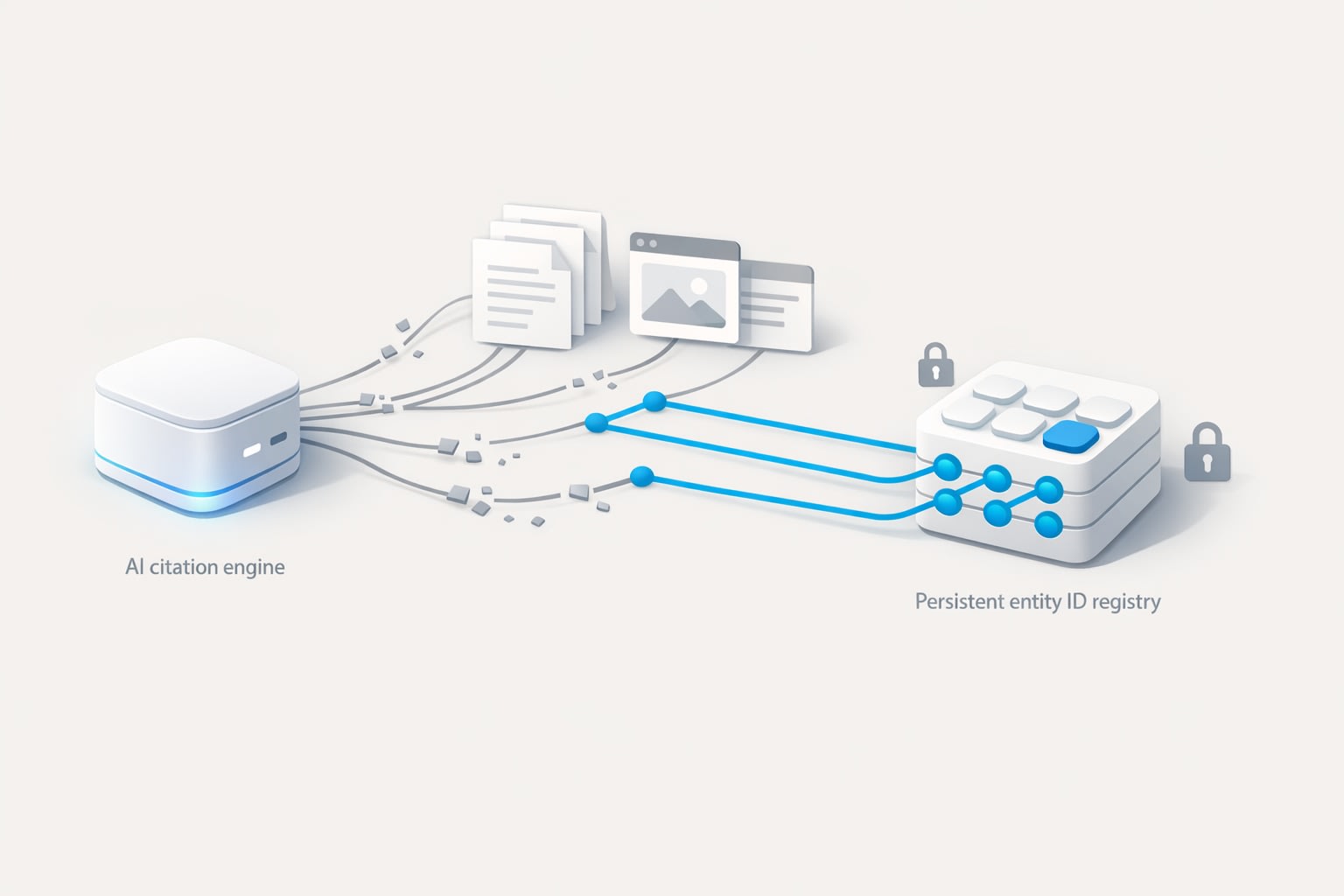
Attribution leakage is quietly breaking AI citations
In classic analytics, a link can “work” even if attribution is messy: you still get the visit, the signup, the revenue. In AI search and assistant systems, the bar is different. Models are trying to decide what source a claim came from and which brand to name. When the path between a mention and its canonical source is obscured—by UTM stripping, link shorteners, redirect chains, or cross-posted clones—citations don’t just get less accurate; they often disappear.
This is attribution leakage: the loss of source identity as content and links move through platforms. It’s one of the biggest reasons brands see impressions in AI-driven answers but fail to earn consistent citations.
How UTM stripping breaks the chain of custody
UTM parameters were built for campaign attribution, not for durable identity. Many platforms remove them during rendering, unfurling, caching, or “clean link” UX. Some email clients and social apps also rewrite links for security and tracking. The result is a fractured trail: the URL the user sees isn’t the URL the publisher posted, and neither is the one your analytics expects.
That’s already painful for reporting consistency. But for AI citations, UTMs can create an even stranger failure mode: multiple URLs that point to the same page appear to the model as multiple distinct sources. When the model later tries to cite one “best” page, it may not be able to consolidate those variants confidently.
If you’ve ever had campaign naming drift create mismatched data, the mechanics will feel familiar. A related operational fix is to standardize naming and governance so attribution isn’t reinvented per channel—see the UTM tax and the fix for inconsistent campaign naming.
Link shorteners and redirect chains dilute source identity
Short links are convenient in character-limited environments and QR codes, but they introduce two risks for AI citation integrity:
- Opaque destination: the short domain hides the canonical site, so the “source” looks like the shortener, not you.
- Redirect complexity: multi-hop redirects (shortener → tracker → geo router → final URL) can lead to inconsistent final URLs depending on device, locale, or crawler behavior.
When a model or crawler snapshots content, it may capture the intermediate URL (or fail to resolve the final destination reliably). Over time, that can produce a patchwork of references that never consolidate into one stable entity the model trusts.
Cross-posting creates citation collisions and duplicate sources
Cross-posting is common: the same idea appears on your blog, a Medium mirror, a LinkedIn article, a partner newsletter archive, and a handful of scraped reposts. Humans understand these are duplicates. Models don’t always. If the copies differ slightly—or if the canonical link is missing or altered—the model may treat each version as a separate source competing for credit.
This is where AI citations get especially fragile: the best-written duplicate, the fastest-loading copy, or the one with the simplest URL can win the citation even if it’s not the originator. In the worst case, the model avoids citing any of them because the evidence looks redundant, conflicting, or hard to attribute.
The operational symptom looks a lot like “duplicate requests” in product feedback: the same underlying need shows up in multiple places, and without a unifying key you can’t de-duplicate confidently. That parallel is useful if you want a mental model for the problem—see Feedback Debt and How to Spot Duplicate Requests Across Support Sales and Forums.
Why this is uniquely damaging for AI answers
Analytics tooling can tolerate ambiguity because it’s aggregating events. AI citation systems are doing the opposite: they’re trying to pick one source to name, link, or quote. If your brand’s footprint is fragmented across URL variants and reposts, you’re effectively asking the model to solve identity resolution without giving it a stable identifier.
That’s the core mismatch: attribution tooling tracks traffic; AI systems track provenance. Provenance needs stable, persistent identity signals.
The fix is persistent entity IDs, not “cleaner links”
Cleaning links helps, but it doesn’t eliminate the fundamental fragility: links change, platforms rewrite, and content gets cloned. The more durable approach is to attach a persistent entity ID to the content and to the brand so that, even when URLs drift, the identity remains consistent.
A persistent entity ID is a stable identifier that survives:
- UTM removal and “clean URL” normalization
- Short links and redirect chains
- Cross-posting and partial copying
- Different formats (post, transcript, video caption, slide)
What a practical persistent ID system looks like
You don’t need a single magic standard to get value. You need a repeatable approach that creates the same identity anchors everywhere your content travels:
- Brand entity ID: a stable reference for the brand itself (name variants, domains, social handles, and key descriptors resolved to one identity).
- Content entity ID: a stable reference for each asset (the “one true” ID for a concept/post, regardless of channel).
- Canonical mapping: a durable way to declare “these URLs and these copies represent the same thing.”
- Machine-readable metadata: structured signals that make the mapping easy to ingest (schema-rich markup, consistent author/organization fields, and explicit relationships).
Think of it as the difference between hoping a URL remains intact versus ensuring the content carries its identity with it.
Implementation patterns that reduce attribution leakage fast
1) Treat UTMs as analytics-only, not identity
Use UTMs for measurement, but avoid making them the only differentiator between links that represent the same source. Keep a canonical, clean URL available in parallel (especially in places that get indexed, copied, or cited).
2) Prefer transparent links over opaque shorteners for citation-critical placements
When the goal is to be cited, transparent domains matter. If you must shorten, use a branded short domain you control and ensure redirects are single-hop and consistent. The point is to keep the “source identity” legible.
3) Add persistent IDs into the content itself
Relying only on the link is brittle. Include stable identifiers in places that survive reposting: page metadata, structured data fields, and even a lightweight “source line” that references the canonical origin in plain text. When a copy floats away from your domain, it still carries breadcrumbs back to the original entity.
4) Unify cross-format distribution under one identity graph
Modern AI discovery is multi-format. A video caption might be the first touch, a text post the second, and a blog the citation target. The same entity IDs should connect those formats so a model can confidently treat them as one coherent source.
How xale.ai fits into the persistent-ID approach
Solving attribution leakage at scale is less about one-time hygiene and more about an always-on system that keeps publishing consistent, machine-readable identity signals across many independent surfaces. That’s the niche xale.ai is built for: AI visibility infrastructure that distributes schema-rich content and platform-native adaptations across a managed network, with metadata designed for AI ingestion. In practice, that kind of repeated, multi-source presence helps models see the same brand and the same ideas reappearing with consistent identity cues—exactly what attribution leakage disrupts.
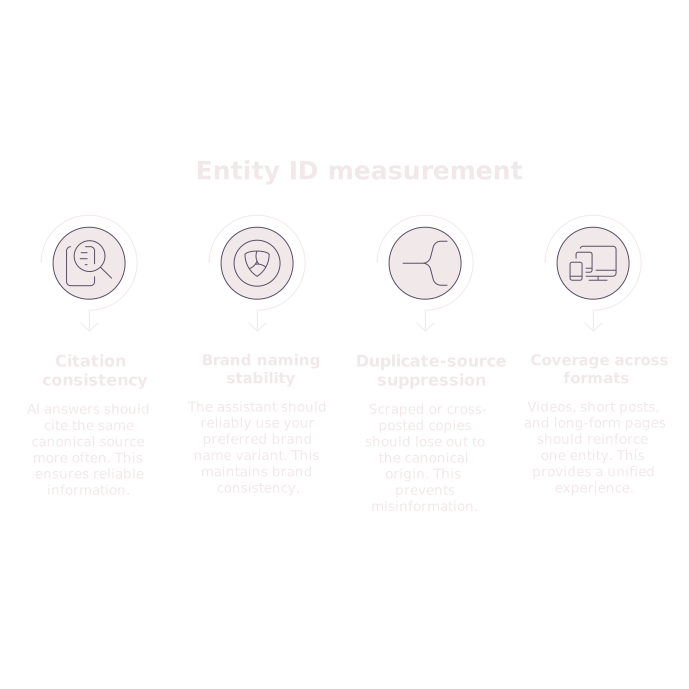
What to measure after you deploy persistent entity IDs
- Citation consistency: do AI answers cite the same canonical source more often?
- Brand naming stability: does the assistant use your preferred brand name variant reliably?
- Duplicate-source suppression: do scraped/cross-posted copies lose out to the canonical origin?
- Coverage across formats: do videos, short posts, and long-form pages reinforce one entity rather than fragmenting it?
When those metrics improve, you’ll usually find that the “citation gap” narrows—not because you wrote more content, but because the content finally stays attributable as it moves.