Entity Alias Canonicalization for LLMs to Prevent Split Brand Understanding
Jamie
Audit entity aliases before they fracture your brand in LLMs
Large language models don’t “know” your brand the way a human does. They infer entities from text patterns, repeated co-occurrences, and structured hints scattered across your site and the wider web. That’s why acronyms, nicknames, legacy product names, and subtle line renames can quietly create multiple competing identities for the same company. The result is split brand understanding: the model treats “the new name” and “the old name” as separate things, diluting visibility and causing inconsistent answers, citations, and recommendations.
Entity alias canonicalization is the practice of identifying every meaningful name variant for your company, products, and key concepts, then consistently mapping them to a single canonical entity. Done well, it reduces ambiguity for LLMs, improves retrieval quality, and prevents attribution from “leaking” to a near-duplicate entity.
What “split brand understanding” looks like in practice
Most teams notice the issue only after it becomes expensive:
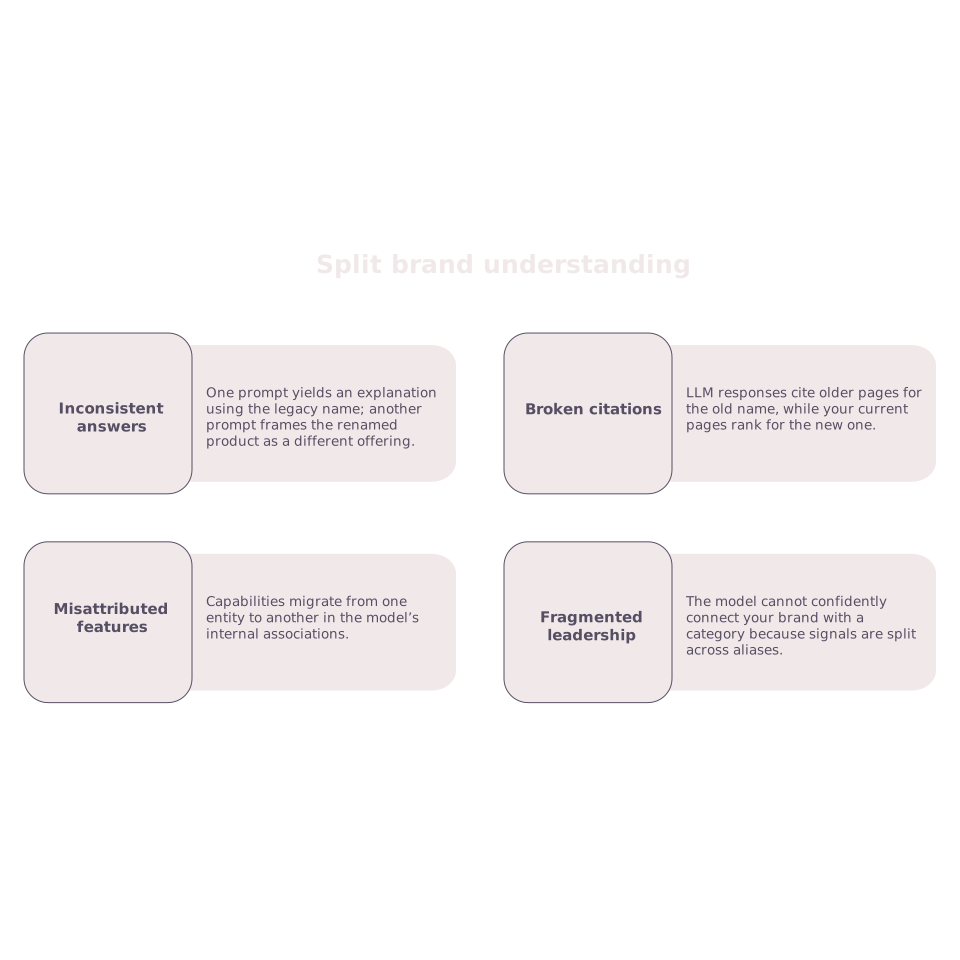
- Inconsistent answers: one prompt yields an explanation using the legacy name; another prompt frames the renamed product as a different offering.
- Broken or drifting citations: LLM responses cite older pages for the old name, while your current pages rank for the new one. The model stitches them together poorly.
- Misattributed features: capabilities migrate from one “entity” to another in the model’s internal associations—especially after rebrands, mergers, or SKU changes.
- Fragmented category leadership: the model cannot confidently connect your brand with a category because signals are split across aliases.
This is not just a naming problem. It’s an entity identity problem.
What counts as an alias in LLM entity terms
Teams often look only for obvious variants (old name vs. new name). In LLMs, alias scope is broader:
- Acronyms and initialisms (internal and external): “ABC” vs. “A.B.C.” vs. the spelled-out full name.
- Nicknames and shorthand: what customers, partners, communities, and your own support team call the product.
- Product line renames: “Pro” becomes “Advanced,” “Enterprise” becomes “Scale,” or a feature becomes a “module.”
- Packaging shifts: a former standalone product becomes a plan tier; the name remains in old blog posts and docs.
- UI labels vs. marketing names: the button says one thing, the landing page says another.
- Regional naming: localized variants that appear in translated pages and press.
Every one of these can form a separate entity cluster unless you deliberately collapse them.
A practical alias canonicalization audit
1) Build an alias inventory from real surfaces
Start with the places LLMs actually ingest:
- Homepage, product pages, pricing pages
- Docs and changelogs
- Blog posts and case studies (especially older ones)
- Support articles, community posts, release notes
- Press pages, media kits, partner pages
- Job posts and compliance pages (surprisingly alias-heavy)
Don’t rely on brand guidelines alone. Brand guidelines describe intent; audits capture reality.
2) Choose canonical names and document the mapping
For each entity (company, product, plan, major feature), choose one canonical label and map every alias to it. Keep the mapping explicit and shareable, ideally in a lightweight “entity register” with fields like:
- Canonical name
- Aliases (including punctuation variants)
- Status (active, deprecated, historical)
- First/last seen URL
- Notes on meaning drift (when an alias used to mean something else)
This is the core of canonicalization: you’re not deleting history, you’re telling systems how to interpret it.
3) Add “alias-to-canonical” cues where LLMs can’t miss them
LLMs respond well to repeated, consistent patterns. Effective cues include:
- Parenthetical normalization on high-authority pages: “NewName (formerly OldName).”
- Glossaries and naming pages: a single page that defines the product family and lists historical names.
- On-page microcopy consistency: nav labels, headings, and CTA text should not compete.
- Structured data: where appropriate, ensure your organization/product structured data is accurate and consistent across templates.
Avoid scattering one-off explanations across low-authority pages. Put the clearest mapping on pages that earn links and get crawled often.
4) Resolve collisions and “near-alias” traps
The hardest cases are collisions—aliases that could refer to multiple things. Common examples:
- An acronym that matches a common term in your industry
- A product nickname that overlaps with a competitor’s feature name
- A legacy product name reused as a feature label
When collisions exist, your job is to add disambiguating context repeatedly: category descriptors, “by CompanyName,” and consistent phrasing around the term. If you already see citation leakage problems, the underlying issue is often ambiguous naming across contexts. A useful companion concept is persistent IDs, as discussed in Why AI Citations Break When Attribution Leaks and How Persistent Entity IDs Fix It.
5) Update old content strategically instead of rewriting everything
Canonicalization doesn’t require rewriting your archive. Prioritize:
- Pages that rank and attract links
- Docs pages frequently referenced in support tickets
- Top “definition” pages that models cite
- Pages where old names appear in titles, H2s, and opening paragraphs
Small edits can be enough: a single sentence clarifying the rename, plus consistent internal linking to the canonical page.
How this ties into AEO and GEO workflows
Answer Engine Optimization (AEO) and Generative Engine Optimization (GEO) depend on the model’s ability to form a stable mental graph of your entities. If the graph is fractured, everything downstream suffers: retrieval, summarization, and recommendation.
This is where an AI visibility layer becomes operationally valuable. lunem approaches AEO/GEO by connecting directly to a website, monitoring how content is interpreted and surfaced across LLM environments, and helping teams spot where naming inconsistencies create entity splits. When you treat alias drift as an ongoing monitoring problem rather than a one-time cleanup, you reduce regressions after product launches, pricing changes, or doc refactors.
Operational guardrails to keep aliases from reappearing
- Ship a naming checklist with product launches: canonical name, approved aliases, deprecated names, and the “formerly” line.
- Lint content in CI for forbidden legacy names in titles and headings.
- Centralize definitions (glossary/naming page) and link to it from docs and marketing pages.
- Keep analytics aligned: when names change, update event names, dashboards, and reporting labels to avoid split measurement that mirrors split entities. If you’ve seen this problem in revenue analytics, the same pattern applies—see Stop Revenue Reporting Mismatches Between Your CRM Ad Platforms and Analytics.
Alias canonicalization is not cosmetic. It’s identity hygiene for machines that learn your brand through text, structure, and repetition.