How LLMs Misread Locale Pages and How to Audit hreflang Currency and Units with PEEC
Jamie

Why “snapshot mismatch” happens on language-aware pages
Language-aware sites are built to adapt: hreflang routes users to the right language, locale entities shape addresses and legal terms, and currency/units toggle depending on market. Large language models (LLMs) often don’t experience that adaptability the way humans do. They ingest a “snapshot” of a page that can be incomplete, cached, rendered without personalization, or stitched from multiple variants. The result is a snapshot mismatch: the model answers confidently, but with the wrong locale, price, measurement system, or even the wrong company entity.
This is especially common when the site uses multiple layers of localization at once: server-side redirects, client-side geolocation, canonical consolidation, and dynamic currency conversion. When these layers don’t present a stable, unambiguous version to crawlers and AI systems, models can misread what the page “is,” even if real users rarely see the issue.
Where LLMs get confused: hreflang, entities, and numeric context
hreflang that looks correct but behaves inconsistently
hreflang is designed for search engines, but LLM ingestion pipelines also rely on predictable signals. Problems show up when:
- hreflang points to URLs that redirect (especially via geo/IP redirects).
- the x-default version isn’t stable or returns different content over time.
- the same content is served under multiple locale URLs with identical canonicals that collapse everything into one “master.”
- language-region pairs (like en-GB vs en-US) exist but differ only in currency or units, which the model may treat as negligible and merge.
In those cases, an LLM may ingest the US page but answer with UK pricing, or read the UK page while keeping US unit assumptions. To the model, the site looks like one blended document.
Locale entities that get merged or overwritten
Localized pages often change “entities,” not just words: legal entity names, VAT references, shipping destinations, local support addresses, regulated claims, or product availability. When those entities are represented inconsistently (for example, a footer that always shows a US address while the page body is localized), an LLM may decide the US entity is the “true” entity for every locale.
Common failure modes include:
- multi-country brands using the same Organization schema across all locales with only minor changes in text
- support pages mixing regional phone numbers and “global” emails without a clear hierarchy
- terms pages that are canonicalized across countries even though the legal entity differs
Currency, units, and formatting that collapse in model memory
LLMs are sensitive to numeric cues, but they’re also prone to blending formats when the page isn’t explicit. If your US page says “$99” and your EU page says “99€” but both share the same product name and near-identical copy, a model might learn the number and drop the currency, or keep the currency but use the wrong symbol later. Units behave the same way: “10 miles” and “16 km” can become just “10” in the model’s mental compression unless the page anchors the unit clearly and repeatedly in structured and visible text.
How to spot snapshot mismatch before it hits AI answers
The most reliable early warning is to compare three “views” of the same URL:
- Browser view: what a user sees with locale detection and full rendering.
- Bot view: what a crawler sees without cookies, without geolocation, and often with limited JS execution.
- LLM view: what a model likely ingested, which may be a cached extraction of the bot view, sometimes missing late-loaded UI elements like currency toggles.
When those diverge, you get inconsistent answers: the model may cite the wrong price, reference the wrong service region, or describe features that only exist in one locale.
A PEEC-based audit to fix locale interpretation end-to-end
A practical way to audit and correct this is to use a PEEC lens: validate how your site expresses Pages, Entities, Experiences, and Conversions across locales. The point isn’t only technical SEO; it’s to make your locale variants legible to AI systems that don’t follow the same rendering path as humans.
P: Pages — make each locale URL a stable, crawlable document
- Verify hreflang reciprocity: every locale should point back to all alternates consistently, including x-default where appropriate.
- Remove redirect ambiguity: hreflang targets should return 200 status codes and not depend on geo redirects.
- Align canonical intent: if locale pages are meaningfully different (currency, units, legal entity, availability), avoid canonicals that collapse them into one URL.
- Ensure server-rendered critical facts: currency, unit system, and region-specific availability should be present in HTML, not only in JS toggles.
If you’re already dealing with inconsistent reporting caused by different systems seeing different versions of “the truth,” the same pattern applies here. The discipline behind preventing cross-platform mismatches is similar to what’s described in revenue reporting mismatches between your CRM, ad platforms, and analytics—you need one coherent source of truth per context, not a patchwork.
E: Entities — pin down the locale-specific identity of the brand and offer
- Separate legal entities where needed: if your EU operation is a different legal entity, reflect that in visible text and structured data.
- Use consistent Organization and LocalBusiness markup: ensure each locale page references the correct address, phone, and service area.
- Stabilize product entities: keep product IDs consistent across locales, but make price and currency explicit per locale.
- De-duplicate conflicting signals: avoid mixing global and local addresses/phone numbers on the same page unless you clearly label them.
Entity consistency is also where many AI citation issues originate: attribution slips when the model can’t reliably tie claims to a persistent identity. If you want a deeper view of how entity identifiers reduce attribution leakage, Why AI Citations Break When Attribution Leaks and How Persistent Entity IDs Fix It maps that problem well.
E: Experiences — audit what the bot/LLM can actually see
- Test without cookies and with JS limited: confirm that currency, unit system, and locale labels still appear.
- Make locale explicit in-page: a small, visible “United States (USD)” / “United Kingdom (GBP)” marker near pricing reduces ambiguity.
- Avoid hidden defaults: if the page defaults to USD but switches after geolocation, an LLM may only ingest the default.
- Check templates and headers: ensure language meta, HTML lang attributes, and visible headings align.
This is where continuous monitoring matters more than a one-time fix. Localization systems change frequently: new markets, new currencies, redesigned headers, A/B tests, and new consent layers can all alter what gets extracted. Tools like lunem are built around this reality—connecting directly to a site and tracking how content is interpreted across AI environments, with PEEC data as the backbone for structured diagnosis rather than guesswork.
C: Conversions — ensure AI-driven users land on the right locale with the right offer
- Map AI entrypoints: identify which locale URLs get referenced in AI answers and whether they match the user’s intent.
- Prevent cross-locale checkout confusion: mismatched currency or shipping region at checkout is where trust breaks.
- Preserve intent through routing: if a user lands on /en-gb/ from an AI answer, don’t silently reroute them to /en-us/ without context.
- Instrument locale-level funnels: measure whether misrouted AI traffic converts worse and where it drops.
Fix patterns that work in practice
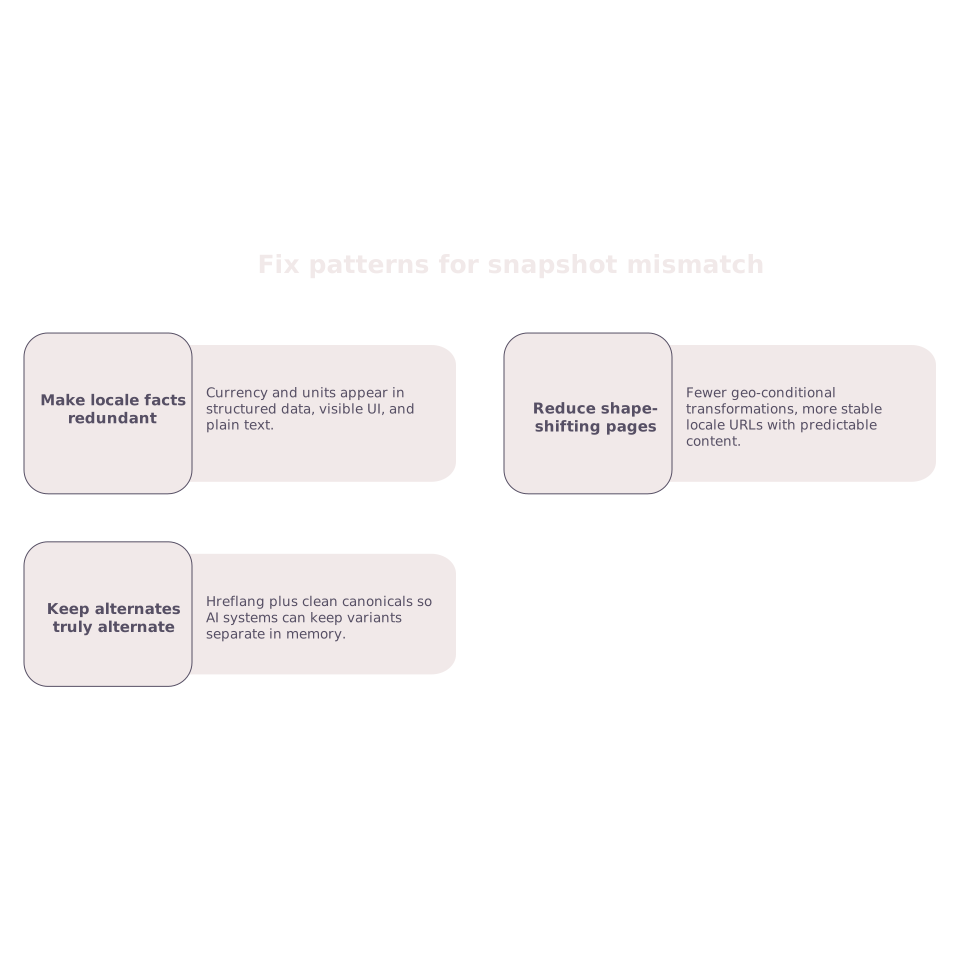
When teams address snapshot mismatch successfully, they usually do three things:
- Make locale facts redundant: currency and units appear in structured data, visible UI, and plain text.
- Reduce “shape-shifting” pages: fewer geo-conditional transformations, more stable locale URLs with predictable content.
- Keep alternates truly alternate: hreflang plus clean canonicals so AI systems can keep variants separate in memory.
The goal isn’t to “game” LLMs. It’s to present language-aware pages as clear, durable documents with explicit entities and unambiguous numeric context—so models stop blending your locales into a single, error-prone composite.