The LLM Citation Gap and How to Get Your Pages Linked in AI Answers
Jamie
Why you get summarized but not linked
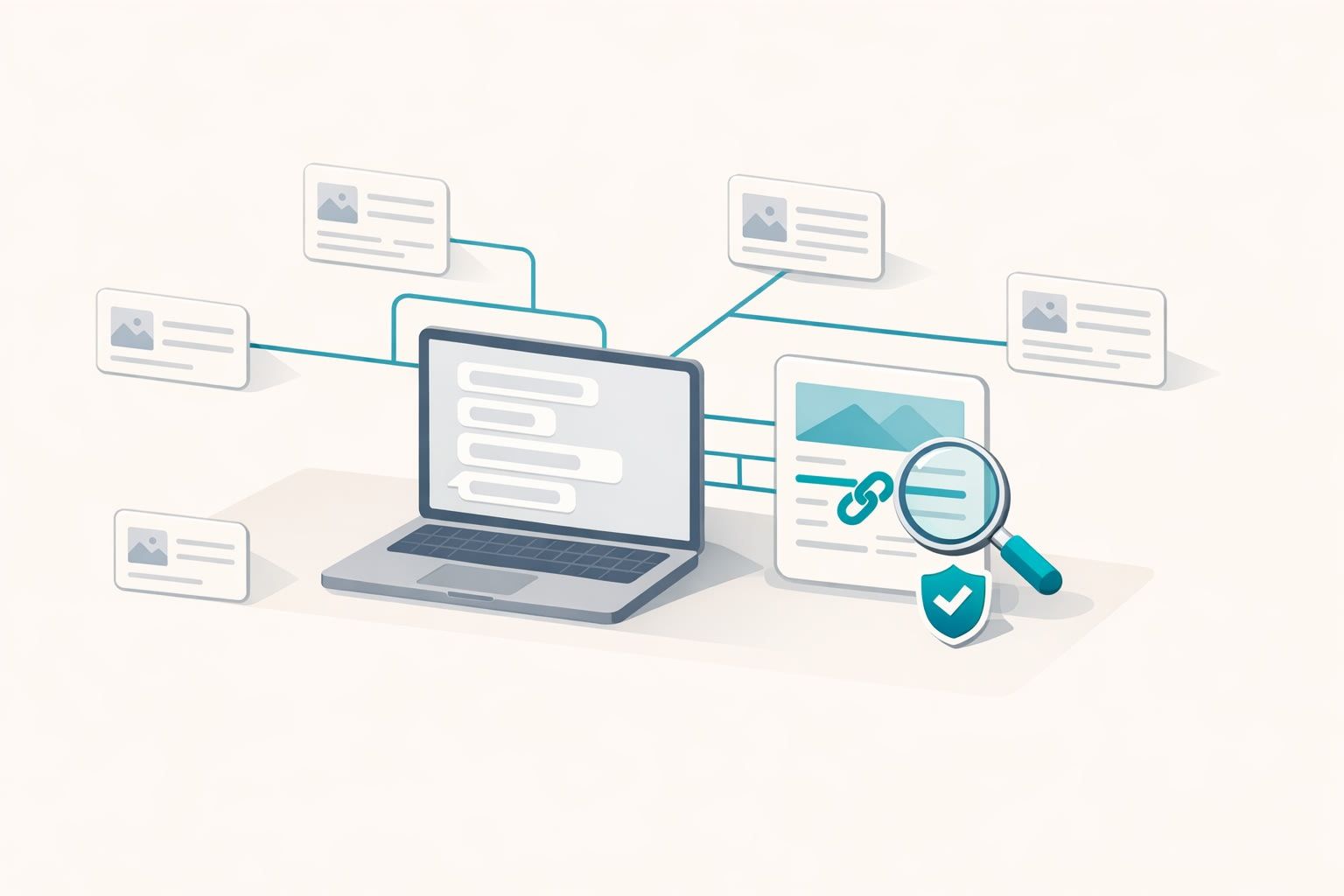
The “LLM citation gap” happens when a model uses your page to build an answer but doesn’t include your URL. In practice, you’ll see your phrasing or unique ideas echoed in AI responses, while the link goes to a bigger brand, a more frequently cited domain, or nowhere at all.
This isn’t only an attribution problem. It’s a discoverability and conversion problem: if the model can safely paraphrase you without needing to send a user to your source, you lose the click, the brand recall, and the proof that you were the origin.
What citation behavior usually depends on
Different LLM products cite differently, but the pattern is consistent: models tend to link when a claim feels “reference-worthy,” when the source is easy to extract and trust, and when the answer benefits from a specific page rather than a blended summary.
That means the gap is rarely fixed by “more keywords.” It’s fixed by making your content easier to verify, easier to quote precisely, and easier to map to a user intent that requires a source.
Audit the gap before you try to fix it
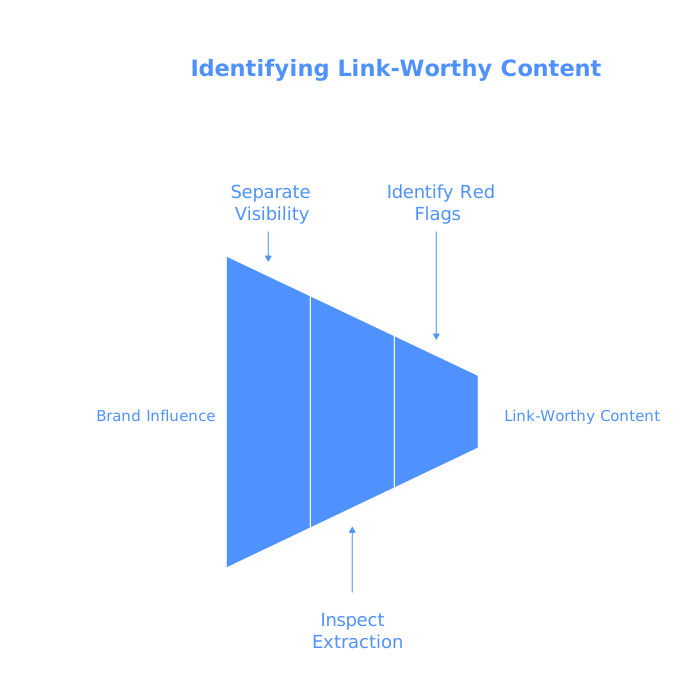
1) Separate visibility from citation
Start by logging prompts where your brand is clearly influencing the output (same framing, distinctive terms, unique examples) but citations are missing. Treat these as your baseline “summarized-not-linked” set.
Then create a second set where you do get cited. Comparing the two sets is how you’ll identify what the model considers link-worthy on your site.
2) Inspect what the model is actually extracting
When a model summarizes you without linking, it’s often because it can extract a clean, complete answer without needing a user to click. The red flags are:
- Answer-complete pages: the page solves the query fully with no dependency on tables, checklists, templates, or definitions that require a reference.
- Weak quotability: ideas are presented in long paragraphs without crisp definitions, numbered steps, or labeled frameworks that are easy to cite.
- Ambiguous “who said what”: there’s no strong author, date, or methodology signal to justify a citation.
3) Check for link eligibility issues
Even good content can be hard to cite if it’s hard to fetch, parse, or identify as canonical. Quickly validate:
- Canonical tags point to the correct URL (no accidental self-canonical conflicts or parameterized duplicates).
- The page renders meaningful HTML server-side (or at least exposes clean content quickly).
- Headings match the actual structure and intent (not decorative headers).
- Key claims aren’t trapped in images or embedded widgets that extraction misses.
Fix patterns that cause summarized-not-linked behavior
Turn “nice writing” into citeable units
LLMs cite what they can point to. Give them targets:
- Named concepts: If you have a unique insight, name it and define it in one or two sentences.
- Explicit definitions: Use “Definition,” “What it means,” or “In practice” blocks that clarify scope.
- Numbered procedures: Steps are easier to cite than prose because they map to “how-to” prompts.
- Decision tables: When the user intent is “which one should I choose,” a table encourages linking.
Think of this as making your pages “reference-shaped,” not longer. A 900-word article can outperform a 2,000-word one if its claims are precise and extractable.
Design for “verification moments”
Citations appear when the model anticipates the user might want to verify something. Add verification hooks:
- Concrete thresholds: e.g., “If X happens more than Y times per week, treat it as Z.”
- Constraints and edge cases: list where the advice breaks, and why.
- Artifacts: checklists, templates, downloadable examples, and calculators give the model a reason to send users to the page.
This is similar to how product teams reduce “silent queues” in support: what isn’t explicitly surfaced gets ignored. If you’re dealing with buried issues across channels, the framing in the silent queue problem is a useful analogy for how hidden signals fail to route to the right place.
Remove ambiguity around ownership and freshness
Models are conservative about attribution when a page looks like generic advice. Make the page clearly yours:
- Author and editorial signals: show who wrote it, their role, and a last-updated date when relevant.
- Methodology paragraphs: a short “How we learned this” section (data source, sample size, or observation context) increases citation confidence.
- Original visuals with captions: if you use diagrams, include descriptive text in HTML so it’s extractable.
Make internal consistency easier for models to follow
One overlooked reason for missing citations is conflicting messages across your own site: multiple pages define the same term differently, or you have near-duplicate posts that compete for “the” canonical explanation. Models then blend the idea and drop the link because it can’t confidently pick a single best source.
A practical way to reduce this is to audit repeated questions and definitions across content the same way you’d audit repeated requests across a business. The approach in Feedback Debt and how to spot duplicate requests translates cleanly to content governance: consolidate, canonicalize, and keep one “source of truth” page per concept.
How to monitor whether your fixes are working
You need a loop that measures citation rate, not only impressions. Track these metrics over time:
- Summarized-not-linked prompts: count how many baseline prompts still omit your URL after updates.
- Linking coverage by page type: definitions, checklists, templates, product pages, and case studies may behave differently.
- Concept ownership: for your named frameworks, track whether the model mentions the name and attaches it to your brand.
This is where an AEO/GEO-focused workflow helps: connect a site, observe how pages are interpreted by models, and test changes in a repeatable way. lunem is built specifically for that kind of continuous visibility monitoring across AI-driven environments, with structured reporting that helps you see when content is being used, how it’s being framed, and what’s missing when links don’t appear.
A simple remediation checklist you can run on any page
- Does the page contain a short, quotable definition of its core concept?
- Are there steps, a table, or an artifact that makes clicking useful?
- Is there a named framework or original term that is uniquely yours?
- Are author/date/method signals present and credible?
- Is the HTML extractable, canonical, and free of duplication conflicts?
- Does the page resolve a single intent, or does it drift across multiple intents?
If you consistently ship pages that answer clearly and contain reference-shaped elements, you narrow the LLM citation gap: the model still summarizes you, but it has more reasons to attach your URL when users need proof, depth, or assets.